

What Are Collocations in English?
Collocations are words that often appear together. They sound “right” to native speakers. For example, we say heavy rain, not “strong rain.”
Learning collocations makes your English sound more natural. It also helps you understand English better when you read or listen.
- Collocations are like word partners.
- They make your sentences more fluent.
- They help you express ideas clearly and correctly.
Why Are Natural World Collocations Important for B2 Learners?
At B2 level, you need to discuss complex topics like the environment. Natural world collocations help you talk about these issues precisely.
Using the correct collocations shows a higher level of English proficiency. It helps you participate in discussions about climate, pollution, and conservation.
- You can talk about environmental problems accurately.
- Your English will sound more advanced and natural.
- You will understand news and articles about the environment easily.
Essential B2 Collocations for the Natural World
Here are some important collocations to help you discuss the natural world and environmental topics. Pay attention to how these words combine.
- Rough weather: This means bad or stormy weather.
- The ship could not sail because of the rough weather.
- Global warming: This is the increase in the Earth’s average temperature.
- Scientists are concerned about the effects of global warming.
- Environmentally friendly: This describes things that do not harm the environment.
- We should choose environmentally friendly products.
- Carbon footprint: This is the amount of carbon dioxide released by your activities.
- Cycling to work helps reduce your carbon footprint.
- Solar energy: This is energy from the sun.
- Many homes now use solar energy to heat water.
- Climate change: This refers to long-term shifts in temperatures and weather patterns.
- Climate change is affecting ecosystems around the world.
- Fragile environment: This means an environment that is easily damaged.
- The Arctic is a fragile environment that needs protection.
- The Earth’s atmosphere: This is the layer of gases surrounding the Earth.
- Pollution is damaging the Earth’s atmosphere.
- Ecological impact: This is the effect that something has on the natural environment.
- The new factory will have a significant ecological impact.
| Collocation | 意味 |
|---|---|
| Rough weather | Bad or stormy weather |
| Global warming | Increase in Earth’s average temperature |
| Environmentally friendly | Not harmful to the environment |
| Carbon footprint | Amount of CO2 released by activities |
| Solar energy | Energy from the sun |
| Climate change | Long-term shifts in weather patterns |
| Fragile environment | Easily damaged natural surroundings |
| The Earth’s atmosphere | Gases surrounding the Earth |
| Ecological impact | Effect on the natural environment |
例
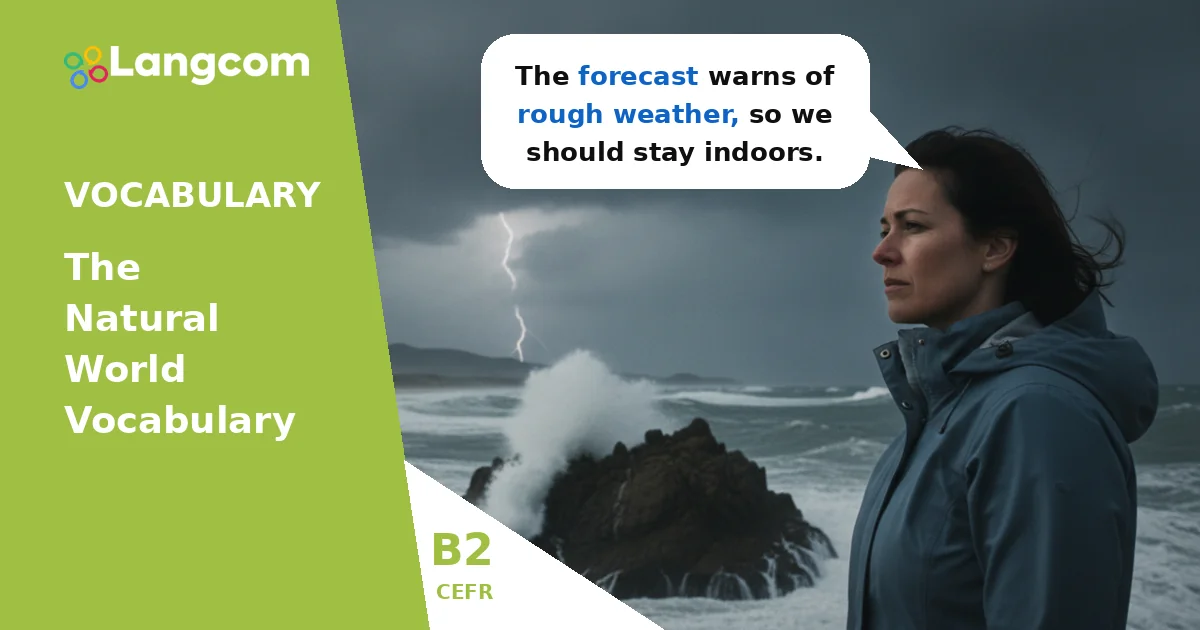
- The forecast warns of rough weather, so we should stay indoors.
- Many reports discuss the serious threat of global warming.
- Using reusable bags is an environmentally friendly habit.
- Companies are trying to reduce their carbon footprint.
- Solar energy is a clean and renewable power source.
- We need to take action to slow down climate change.
- Coral reefs are a fragile environment that is easily destroyed.
- Gases from factories can harm the Earth’s atmosphere.
- Scientists are studying the ecological impact of deforestation.
練習
スペイン語話者がよく犯す間違い
Spanish speakers sometimes translate word-for-word, which can lead to incorrect collocations. Here are some common errors:
- “Strong weather” instead of rough weather: In Spanish, you might say “tiempo fuerte.” In English, for bad weather, we use rough または severe.
- 誤り: We had strong weather yesterday.
- 正しい: We had rough weather yesterday.
- “Climatic change” instead of climate change: The adjective for “climate” is “climatic,” but for this specific phenomenon, the noun climate is used as an adjective.
- 誤り: Climatic change is a big problem.
- 正しい: Climate change is a big problem.
- “Energetic solar” instead of solar energy: In English, the adjective usually comes before the noun.
- 誤り: Energetic solar is popular.
- 正しい: Solar energy is popular.
よくある質問
What is a collocation?
A collocation is a pair or group of words that are often used together. For example, we say heavy rain, not ‘strong rain.’ These combinations sound natural to native English speakers.
Why is it important to learn collocations at B2 level?
At B2 level, learning collocations helps you improve your fluency and accuracy. It allows you to express more complex ideas, especially about topics like the environment, and makes your English sound more natural and advanced.
Can I guess collocations?
Sometimes you can guess, but often collocations are not logical. For instance, you might think ‘big impact’ but the common collocation is significant impact または ecological impact. It’s best to learn them as fixed phrases.
How can I remember new collocations?
Try to learn new words in groups, not individually. When you learn a noun like environment, also learn its common partners like fragile environment または protect the environment. Use them in sentences and review them regularly.




コメント 0 件