
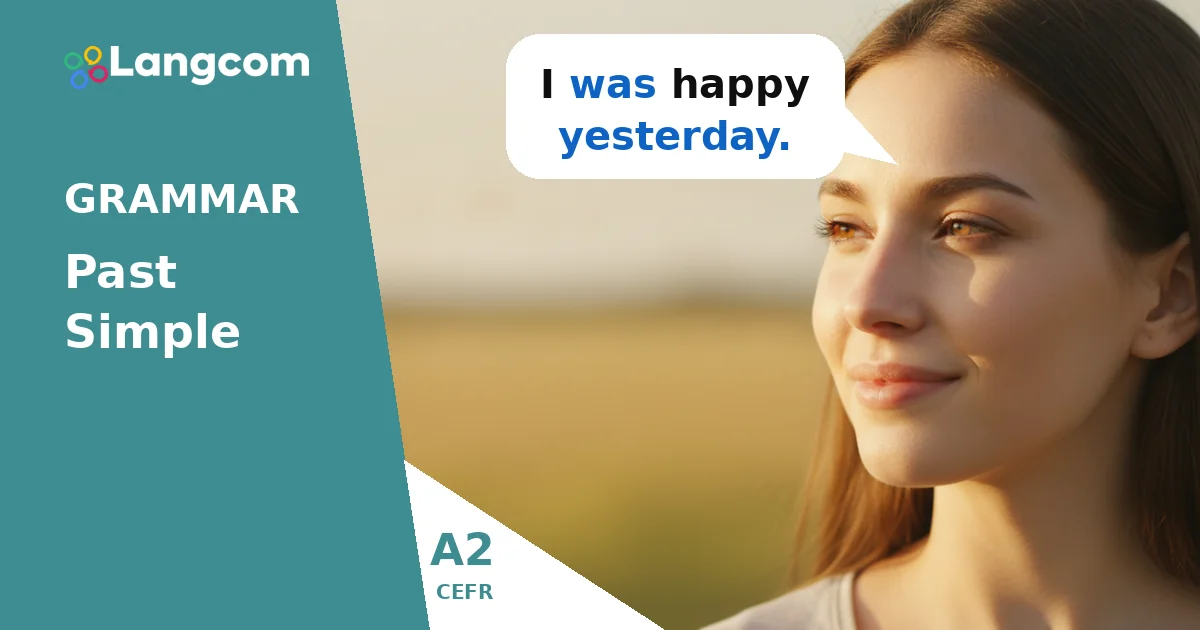

What is the Past Simple Tense?
We use the Past Simple to talk about things that are finished. These things happened at a specific time in the past. It is like saying ‘ayer’ or ‘la semana pasada’ in Spanish.
-
Finished actions: Events that started and ended in the past.
-
Past states: How things were in the past, but are not now.
-
Series of past actions: When one thing happened after another.
✍️ ¿No sabes en qué nivel estás?
Realiza nuestra prueba de nivel gratuita y recibe comentarios personalizados de examinadores certificados por Cambridge.
Realice nuestra prueba de nivel GRATUITAHow Do We Form the Past Simple with 'To Be'?
The verb to be is special. It changes to was o were in the Past Simple.
Affirmative
-
Uso was for I, he, she, it.
-
Uso were for you, we, they.
Negative
-
Add not after was o were.
-
Short forms are wasn't y weren't.
Questions
-
Put Was o Were before the subject.
How Do We Form the Past Simple with Regular Verbs?
Most verbs in English are regular. To make them Past Simple, we add -ed to the base form of the verb.
Affirmative
-
Add -ed to the verb. This form is the same for all subjects (I, you, he, she, it, we, they).
Negative
-
Uso did not o didn't before the base form of the verb.
-
Remember: the main verb does NOT have -ed when you use didn't.
Questions
-
Uso Did before the subject, then the base form of the verb.
-
The main verb does NOT have -ed when you use Did.
What About Irregular Verbs?
Some verbs are irregular. They do not follow the -ed rule. They change their form completely in the Past Simple.
-
You need to learn these verbs by heart. Common examples are go (went), see (saw), have (had), make (made).
Affirmative
-
Use the special irregular past form. This form is the same for all subjects.
Negative and Questions
-
Just like regular verbs, use did not/didn't y Did.
-
After did o didn't, always use the base form of the irregular verb.
| Verb ends in... | Rule | Example |
|---|---|---|
| Most verbs | Add -ed | work → worked |
| -e | Add -d | decide → decided |
| Consonant + -y | Change -y to -i, then add -ed | carry → carried |
| Vowel + -y | Add -ed | stay → stayed |
| One vowel + one consonant (stressed final syllable) | Double the last consonant, then add -ed | stop → stopped |
| One vowel + one consonant (not stressed final syllable, or British English for -l) | Add -ed (or double -l in British English) | travel → travelled (UK), traveled (US) |
Ejemplos
- I was happy yesterday.
- They were at the party.
- Was he tired?
- We weren't hungry.
- She worked in a bank last year.
- Did you finish your homework?
- They didn't travel much.
- He went to the cinema.
- I saw a great film.
- Did she eat breakfast?
- We didn't know the answer.
Práctica
¿Estás listo para obtener tu certificado?
El curso Langcom prepara a los alumnos para los exámenes de Cambridge, IELTS, TOEFL, DELE, SIELE y Michigan.
Empieza a utilizar LangcomErrores habituales de los hispanohablantes
Spanish speakers often make these mistakes with the Past Simple:
-
Uso de did with to be: In Spanish, you might say '¿Estuviste tú?' (Did you were?). In English, it's incorrect. Always say Were you...? o Was he...?
Incorrecto: Did you were at home?
Correcto: Were you at home?
-
Not using the base form after did/didn't: Recuerda que, did already shows the past. The main verb must be in its base form.
Incorrecto: I didn't went to the shop.
Correcto: I didn't go to the shop.
Incorrecto: Did he worked yesterday?
Correcto: Did he work yesterday?
Preguntas más frecuentes
When should I use the Past Simple?
Use the Past Simple for actions, events, or states that started and finished in the past. It describes something that is completely over, often with a specific time mentioned or understood, like yesterday o last week.
How do I know if a verb is regular or irregular?
Most verbs are regular and form their past simple by adding -ed. Irregular verbs have unique forms (e.g., go - went, eat - ate). There is no simple rule; you need to learn the common irregular verbs by memorizing them.
Is the Past Simple important for the A2 Key exam?
Yes, the Past Simple is very important for the A2 Key (KET) exam. You will need to use it correctly in writing tasks (like emails or short stories) and speaking parts to describe past events and experiences.
Can I use the Past Simple for habits?
Yes, you can use the Past Simple for habits that happened regularly in the past but do not happen now. For example, When I was a child, I played football every day.


0 Comentarios