
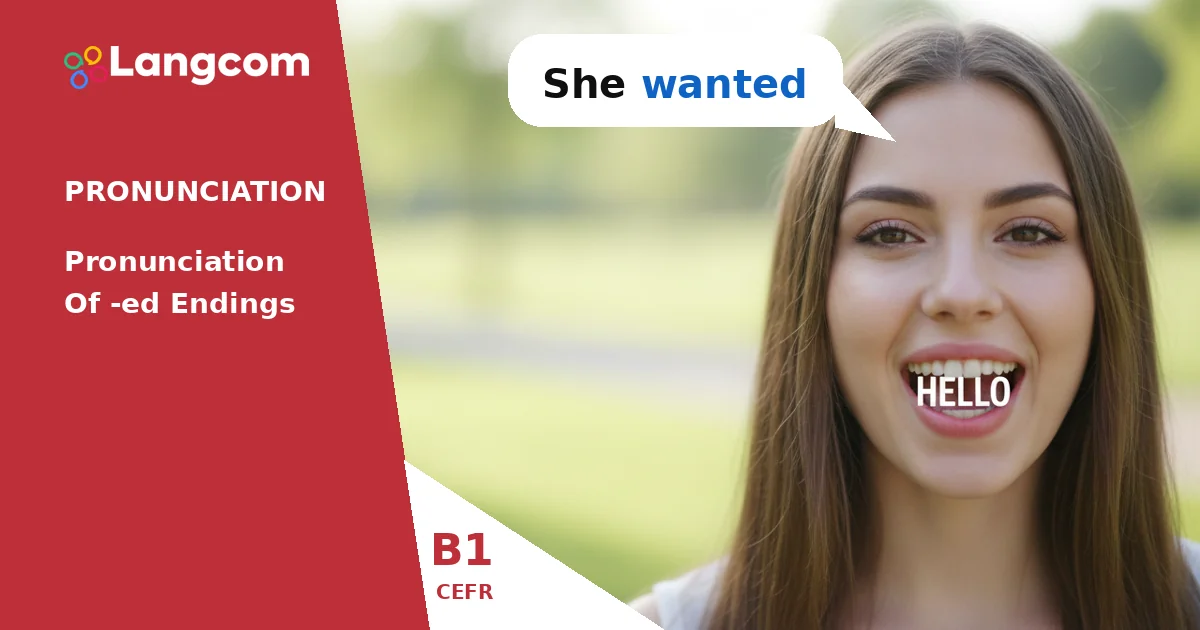

En -ed ending in regular past tense verbs and past participles has three different pronunciations: /ɪd/, /t/, o /d/. The sound depends on the final sound of the base verb before -ed is added. The most important rule to remember is that you only add an extra syllable (the /ɪd/ sound) when the base verb ends with a /t/ o /d/ sound. For all other verbs, the -ed ending does not add an extra syllable; it simply blends into the final sound of the verb, becoming either /t/ o /d/. Mastering these rules will significantly improve your spoken English clarity and naturalness.
Why is -ed Pronunciation Important?
Correct pronunciation of -ed endings makes your English sound more natural and easier to understand. Mispronouncing these common endings can sometimes confuse listeners or make your speech sound less fluent.
It’s a key part of speaking clearly, especially when talking about past events or using passive voice constructions.
🎓 Aprende inglés con el método mixto
Grupos reducidos · Tutor de IA disponible las 24 horas del día, los 7 días de la semana · Preparación para los exámenes de Cambridge
Planes de $39 $79 al mes
The Three Sounds of -ed Endings
En -ed ending has three distinct sounds. The sound you use depends on the last sound of the verb before you add -ed.
- /ɪd/ (o /əd/): This sound adds an extra syllable.
- /t/: This sound does not add an extra syllable.
- /d/: This sound also does not add an extra syllable.
Rule 1: The /ɪd/ Sound (Extra Syllable)
This is the easiest rule to remember because it’s the only one that adds an extra syllable to the word.
- Use the /ɪd/ sound when the base verb ends with a /t/ sound or a /d/ sound.
- Think of verbs like want (ends in /t/) or need (ends in /d/).
- When you add -ed, they become want/ɪd/ y need/ɪd/.
Rule 2: The /t/ Sound
This sound does not add an extra syllable. It’s used after voiceless sounds.
- Use the /t/ sound when the base verb ends with a voiceless consonant sound.
- Voiceless sounds are made without vibrating your vocal cords. Try saying /p/, /k/, /f/, /s/, /ʃ/ (like in wash), or /tʃ/ (like in watch).
- For example, walk (ends in /k/) becomes walk/t/. Watch (ends in /tʃ/) becomes watch/t/.
Rule 3: The /d/ Sound
This sound also does not add an extra syllable. It’s used after voiced sounds.
- Use the /d/ sound when the base verb ends with a voiced consonant sound or a vowel sound.
- Voiced sounds are made by vibrating your vocal cords. Try saying /b/, /g/, /v/, /z/, /ʒ/ (like in measure), /dʒ/ (like in change), /m/, /n/, /ŋ/ (like in sing), /l/, /r/, or any vowel sound.
- For example, play (ends in a vowel sound) becomes play/d/. Love (ends in /v/) becomes love/d/.
Voiced vs. Voiceless Sounds: A Quick Guide
To tell if a sound is voiced or voiceless, put your hand on your throat and make the sound.
- Voiced sounds: You will feel a vibration in your throat. Examples: /b/, /d/, /g/, /v/, /z/, /m/, /n/, and all vowel sounds.
- Voiceless sounds: You will not feel a vibration. Examples: /p/, /t/, /k/, /f/, /s/, /h/.
This distinction is crucial for applying rules 2 and 3 correctly.
| Ending Sound of Base Verb | -ed Pronunciation | Example Verb | Pronunciation |
|---|---|---|---|
| /t/ o /d/ | /ɪd/ (extra syllable) | want | want/ɪd/ |
| Voiceless consonant (e.g., /p/, /k/, /f/, /s/, /ʃ/, /tʃ/) | /t/ (no extra syllable) | walk | walk/t/ |
| Voiced consonant (e.g., /b/, /g/, /v/, /z/, /m/, /n/) or Vowel sound | /d/ (no extra syllable) | play | play/d/ |
Ejemplos
- She wanted to visit Paris.
- They decided to stay home.
- He walked to the store.
- We watched a movie last night.
- I played tennis yesterday.
- The dog loved its new toy.
- They finished their homework quickly.
- She called her friend.
Práctica
✍️ ¿No sabes en qué nivel estás?
Realiza nuestra prueba de nivel gratuita y recibe comentarios personalizados de examinadores certificados por Cambridge.
Realice nuestra prueba de nivel GRATUITAErrores habituales de los hispanohablantes
Spanish speakers often make two main mistakes with -ed endings:
- Adding an extra syllable to all -ed verbs: It’s common to pronounce words like walked as *walk-ed* (/wɔːkɪd/) instead of walk/t/ (/wɔːkt/). Remember, the /ɪd/ sound is only for verbs ending in /t/ o /d/.
- Confuso /t/ y /d/ sounds: Sometimes, the distinction between look/t/ y love/d/ can be difficult. Focus on whether the final sound of the base verb is voiced or voiceless. Practice feeling the vibration in your throat to help.
Preguntas más frecuentes
How many ways can I pronounce -ed?
There are three ways to pronounce the -ed ending: /ɪd/, /t/, y /d/.
What is a ‘voiceless’ sound?
A voiceless sound is made without vibrating your vocal cords. If you put your hand on your throat, you won’t feel any movement when you make a voiceless sound, like /p/ o /s/.
Why do some -ed verbs have an extra syllable?
An extra syllable (the /ɪd/ sound) is added only when the base verb already ends with a /t/ o /d/ sound. This makes the pronunciation clearer and easier, as in start/ɪd/ o decid/ɪd/.
Does this apply to all past tense verbs?
These rules apply to regular past tense verbs and past participles. Irregular verbs, like go (went) or eat (ate), have different forms and do not use the -ed ending.
How can I practice -ed pronunciation?
Listen carefully to native speakers, record yourself saying verbs with -ed, and pay attention to the final sound of the base verb. The interactive exercise in this lesson is a great way to practice identifying the correct sounds.



0 Comentarios