

Why is -ED Pronunciation Important?
Correctly pronouncing the -ed ending is key for clear English communication. It helps you sound more natural and be understood easily by native speakers.
Mispronouncing these endings can sometimes change the meaning of what you say or make your speech harder to follow.
🎓 Изучайте английский по смешанной методике
Небольшие группы · ИИ-репетитор 24/7 · Подготовка к экзаменам Кембриджского университета
Планы от $39 $79 в месяц
How Many Ways Can We Pronounce -ED?
There are three main ways to pronounce the -ed ending in regular past tense verbs and past participles.
- Сайт /ɪd/ sound (like in wanted)
- Сайт /t/ sound (like in looked)
- Сайт /d/ sound (like in played)
The sound depends on the last sound of the base verb, not the last letter.
When Do We Say /ɪd/?
You pronounce -ed как /ɪd/ when the base verb ends with a /t/ sound or a /d/ звук.
- This rule adds an extra syllable to the word.
- Think of it as adding a short 'i' sound before the 'd'.
Примеры:
- want (ends in /t/) → wanted /wɒntɪd/
- need (ends in /d/) → needed /niːdɪd/
- start (ends in /t/) → started /stɑːrtɪd/
- decide (ends in /d/) → decided /dɪˈsaɪdɪd/
When Do We Say /t/?
You pronounce -ed как /t/ when the base verb ends with a voiceless sound (except /t/).
- This rule does NOT add an extra syllable.
- Voiceless sounds are made without vibrating your vocal cords.
Common voiceless sounds:
- /p/ (как в stop)
- /k/ (как в look)
- /f/ (как в laugh)
- /s/ (как в pass)
- /ʃ/ (как в wash)
- /tʃ/ (как в watch)
Примеры:
- look (ends in /k/) → looked /lʊkt/
- wash (ends in /ʃ/) → washed /wɒʃt/
- watch (ends in /tʃ/) → watched /wɒtʃt/
- help (ends in /p/) → helped /helpt/
When Do We Say /d/?
You pronounce -ed как /d/ when the base verb ends with a voiced sound (except /d/) or a vowel sound.
- This rule also does NOT add an extra syllable.
- Voiced sounds are made by vibrating your vocal cords.
Common voiced sounds:
- /b/ (как в rob)
- /g/ (как в hug)
- /v/ (как в love)
- /z/ (как в amaze)
- /ʒ/ (как в massage)
- /dʒ/ (как в judge)
- /m/, /n/, /l/, /r/ (e.g., call, clean)
- All vowel sounds (e.g., play, agree)
Примеры:
- play (ends in vowel sound) → played /pleɪd/
- love (ends in /v/) → loved /lʌvd/
- clean (ends in /n/) → cleaned /kliːnd/
- call (ends in /l/) → called /kɔːld/
What Are Voiced and Voiceless Sounds?
To understand the /t/ и /d/ sounds better, it's helpful to know about voiced and voiceless sounds. This is a key concept in English pronunciation.
- Voiced sounds: These are sounds made when your vocal cords vibrate. You can feel this vibration if you touch your throat while making the sound.
- Voiceless sounds: These are sounds made without your vocal cords vibrating. Only air passes through your mouth.
Try this simple test:
- Place your hand on your throat.
- Say the sound /s/ (like in snake). Do you feel a vibration? No. So, /s/ is a voiceless sound.
- Now say the sound /z/ (like in zebra). Do you feel a vibration? Yes. So, /z/ is a voiced sound.
This test helps you identify the final sound of a verb and apply the correct -ed pronunciation rule.
| Final Sound of Base Verb | -ED Pronunciation | Example Verb | Произношение |
|---|---|---|---|
| /t/ или /d/ | /ɪd/ (extra syllable) | wait | waited /weɪtɪd/ |
| Voiceless sounds (e.g., /p, k, f, s, ʃ, tʃ/) | /t/ (no extra syllable) | look | looked /lʊkt/ |
| Voiced sounds (e.g., /b, g, v, z, m, n, l, r/) or Vowel sounds | /d/ (no extra syllable) | play | played /pleɪd/ |
Примеры
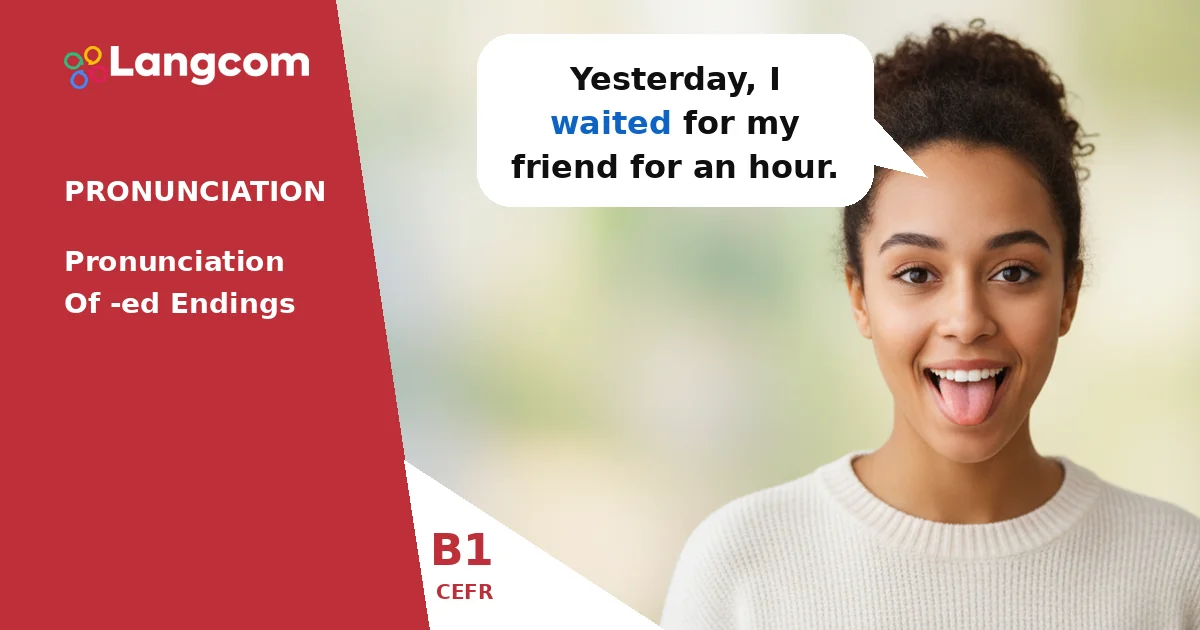
- Yesterday, I waited for my friend for an hour.
- She changed her mind about the trip.
- We played football in the park last weekend.
- The company needed more time to finish the project.
- His speech included many interesting facts.
- The movie ended with a surprising twist.
- They watched a new series on TV last night.
- He stopped working when it got dark.
- The dog barked loudly at the mailman.
Практика
✍️ Not sure which level you are?
Take our free placement test and get personalized feedback from certified Cambridge examiners.
Пройдите наш БЕСПЛАТНЫЙ тест на определение местаРаспространенные ошибки у носителей испанского языка
Many Spanish speakers tend to pronounce the -ed ending as /ɪd/ for all regular past tense verbs. This is because Spanish often adds a vowel sound when consonants cluster, or it might be influenced by how past participles are formed in Spanish (e.g., hablado, comido).
However, in English, this /ɪd/ sound is only correct for verbs ending in /t/ или /d/ sounds. For other verbs, adding an extra syllable can make your speech sound less natural.
- Неправильно: I walk-ed /wɔːkɪd/ to the store.
- Правильно: I walked /wɔːkt/ to the store.
- Неправильно: She clean-ed /kliːnɪd/ the house.
- Правильно: She cleaned /kliːnd/ the house.
Pay close attention to the final sound of the base verb to avoid this common error and improve your fluency.
Часто задаваемые вопросы
Is this rule for all words ending in -ED?
No, these pronunciation rules apply specifically to the -ed ending of regular past tense verbs and past participles. They do not apply to adjectives that happen to end in -ed but are not derived from verbs, like naked или wretched.
Как можно эффективно тренировать эти звуки?
The best way to practice is by listening carefully to native speakers and then repeating. You can also record yourself and compare your pronunciation. Focus on minimal pairs (words that differ by only one sound) or groups of words that share the same -ed ending sound. Reading aloud is also very helpful.
Does this apply to irregular verbs?
No, these rules are only for regular verbs that form their past tense and past participle by adding -ed. Irregular verbs have unique past tense and past participle forms (e.g., go - went - gone, eat - ate - eaten) and do not follow these -ed pronunciation patterns.
Will mastering these rules help me in English exams?
Yes, absolutely! Clear and accurate pronunciation of -ed endings will significantly improve your score in speaking sections of exams like Cambridge B1 Preliminary (PET) or IELTS. Examiners look for natural pronunciation and intelligibility, which these rules directly address.




0 Комментариев