

What Are Wishes and Regrets in English?
When we talk about wishes, we are imagining a situation that is different from reality. This can be about the present, the past, or the future.
Regrets are feelings of sadness or disappointment about something that happened or didn’t happen in the past. We often wish things had been different.
✍️ Non sai a quale livello ti trovi?
Fai il nostro test di livello gratuito e ricevi un feedback personalizzato da esaminatori certificati Cambridge.
Fai il nostro test di livello GRATUITOHow Do We Express Wishes About the Present?
To express a wish about a present situation that you want to be different, we use wish + past simple.
-
Use wish + past simple for situations that are not true now, but you want them to be true.
-
You can also use wish + could + infinitive to express a wish about an ability you don’t have now.
-
For I, he, she, it, we often use were instead of was in formal English, but both are common in spoken English.
How Do We Express Wishes About the Future?
To express a wish about a future event or situation that you want to be different, we use specific structures.
-
Use wish + would + base verb when you want someone else to do something, or for a situation to change. This often implies annoyance or impatience.
-
Do NOT use would to make a wish about yourself. Instead, use wish + could + base verb to talk about your own future ability or possibility.
How Do We Express Regrets About the Past?
When we regret something that happened or didn’t happen in the past, we use the past perfect tense after wish.
-
Use wish + past perfect to express regret about a past action or situation that cannot be changed.
-
This structure means you are sorry about something that happened, or that you did not do something you wanted to do.
When Do We Use “If Only…”?
If only… has the same meaning as I wish… but it is often stronger and more emphatic. It expresses a deeper regret or a more intense desire for a situation to be different.
-
You use the same verb forms after if only as you do after wish (past simple for present, past perfect for past).
What About “Should Have + Past Participle”?
We use should have + past participle to express regret about our own past actions. It means we believe we made a mistake or did not do the right thing.
-
This structure shows that you now realize a different action would have been better.
-
It is specifically for reflecting on your own choices and actions.
Wish vs. Hope: What’s the Difference?
It is important to distinguish between wish e hope. They are not interchangeable.
-
We use hope when we talk about something that is realistic, possible, or likely to happen in the future.
-
We use wish when we talk about something that is unreal, impossible, or very unlikely to happen.
| Type of Wish/Regret | Structure | Example |
|---|---|---|
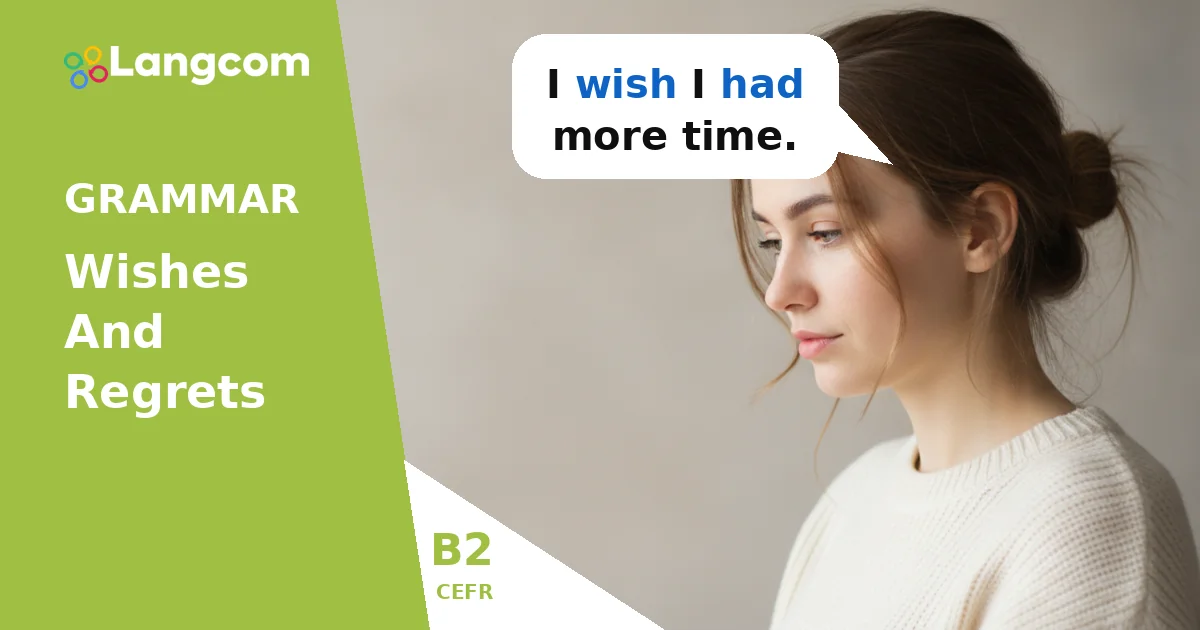
| Present Wish (unreal) | wish + past simple | I wish I had more time. |
| Present Wish (ability) | wish + could + infinitive | I wish I could speak Russian. |
| Future Wish (others/situations) | wish + would + base verb | I wish it would stop raining. |
| Future Wish (own ability) | wish + could + infinitive | I wish I could get a better job. |
| Past Regret | wish + past perfect | I wish I hadn’t been so lazy. |
| Past Regret (own action) | should have + past participle | I should have locked the door. |
Esempi
- I wish I had more time.
- I wish I could speak Russian.
- If only it were that simple.
- I wish it would stop raining.
- I wish I could get a better job.
- I wish I hadn’t been so lazy at school.
- If only I had studied harder for the exam.
- It’s my fault. I should have locked the door.
- I hope you get better soon.
- I hope nothing has happened to them.
Esercitazione
Ready to earn your certificate?
Langcom prepares students for Cambridge, IELTS, TOEFL, DELE, SIELE and Michigan exams.
Get started with LangcomErrori comuni per chi parla spagnolo
Spanish speakers often make these common mistakes:
- Using present tense after wish for present wishes:
Errato: I wish I am rich.
Corretto: I wish I were rich. (or I wish I was rich.) - Confuso wish e hope:
Incorrect (for a realistic future event): I wish you would get better soon.
Corretto: I hope you get better soon. - Using would for one’s own future wishes:
Errato: I wish I would fly.
Corretto: I wish I could fly. - Direct translation of ‘Ojalá’: While ‘Ojalá’ can express strong wishes or hopes, its English equivalents require specific grammatical structures (e.g., If only I knew! oppure I wish I knew!). Do not translate directly word-for-word.
Domande frequenti
What is the main difference between ‘wish’ and ‘hope’?
We use hope for things we want to happen that are possible or likely, like I hope it doesn’t rain tomorrow. We use wish for things that are impossible, unreal, or very unlikely, or for expressing regret, like I wish I could fly.
Can I use ‘was’ instead of ‘were’ after ‘wish’ for I/he/she/it?
Yes, you can use was instead of were after wish for I, he, she, e it in informal spoken English. For example, I wish I was taller is common, though I wish I were taller is preferred in more formal contexts.
When do we use ‘should have + past participle’?
We use should have + past participle to express regret about a past action that you did or didn’t do. It means you now think it was a mistake, for example, I should have called her.
Is ‘if only’ more formal than ‘I wish’?
No, if only is not necessarily more formal than I wish. It is usually used to express a stronger, more intense feeling of wish or regret. It adds emphasis to the statement.




0 Commenti