

What is Intonation and Why is it Important for Emphasis?
Intonation refers to the rise and fall of your voice when you speak. It’s like the melody of a sentence.
While individual word stress highlights syllables within a word, intonation applies to entire phrases or sentences, changing pitch to convey meaning or emotion.
- It helps listeners understand your attitude.
- It signals what information is new or important.
- It can completely change the meaning of a sentence without changing the words.
✍️ Du bist dir nicht sicher, auf welchem Niveau du bist?
Machen Sie unseren kostenlosen Einstufungstest und erhalten Sie individuelles Feedback von zertifizierten Cambridge-Prüfern.
Machen Sie unseren KOSTENLOSEN EinstufungstestHow Does Intonation Show Emphasis?
When you want to emphasize a particular word, you typically make your voice’s pitch higher or lower on that word, and often prolong the vowel sound slightly.
This draws the listener’s attention to the emphasized word, indicating its significance.
- Highlighting New Information: You can emphasize a word to introduce new or contrasting information. For example: “I bought a *blue* car, not a red one.”
- Expressing Emotion: Intonation is key to showing feelings like surprise, anger, excitement, or doubt. For example, a sharp rising tone can show disbelief.
- Correcting Misunderstandings: When you want to correct someone, you emphasize the incorrect part of their statement. For example: “No, I said I’m leaving *tomorrow*, not today.”
- Showing Agreement or Disagreement: A strong falling tone can show firm agreement, while a rising tone might show hesitation.
Common Intonation Patterns for Emphasis
At C1 level, you should be aware of how different pitch movements create specific effects.
- Rising-Falling Tone: This is very common for strong statements, certainty, or strong emotions. The pitch rises on the stressed word and then falls. For example: “That was an *amazing* performance!” (showing strong positive feeling).
- Falling Tone: Often used for definitive statements, commands, or strong agreement. The pitch falls at the end of the phrase. For example: “I *insist* you take it.” (showing firmness).
- Rising Tone: Can indicate uncertainty, questions, or surprise. When used for emphasis, it might suggest disbelief or a challenge. For example: “You *actually* finished it?” (showing surprise/disbelief).
- High Level Tone: Holding a high pitch on a word can also create emphasis, often for contrast or to highlight a specific detail. For example: “She was *the* person I wanted to meet.”
| Intonation Pattern | Common Use for Emphasis | Beispiel |
|---|---|---|
| Rising-Falling | Strong statement, certainty, strong emotion (excitement, anger) | That’s *impossible*! |
| Falling | Definitive statement, command, strong agreement | I *told* you so. |
| Rising | Surprise, disbelief, questioning a statement, challenging | You *really* did that? |
| High Level | Highlighting contrast, specific detail, or strong focus on one item | This is *the* book everyone is talking about. |
Beispiele
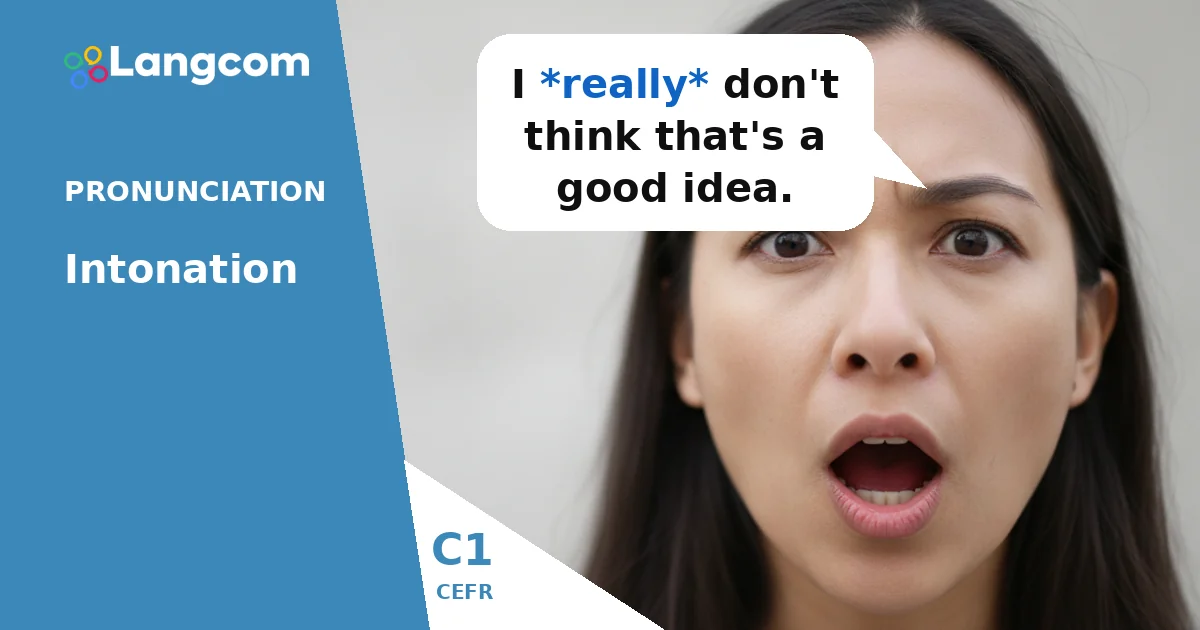
- I *really* don’t think that’s a good idea. (Emphasizes strong disagreement)
- He said he’d be here at *eight*, not nine. (Correcting a time)
- You *can’t* be serious! (Expressing disbelief or shock)
- It was *absolutely* the best movie I’ve ever seen. (Showing strong positive opinion)
- She *never* told me about that meeting. (Highlighting a failure to inform)
- I *thought* you understood. (Expressing disappointment or mild accusation)
- This is *exactly* what I needed! (Showing strong satisfaction)
Übung
Bist du bereit, dein Zertifikat zu erwerben?
Der Kurs Langcom bereitet die Teilnehmer auf die Prüfungen von Cambridge, IELTS, TOEFL, DELE, SIELE und Michigan vor.
Erste Schritte mit LangcomHäufige Fehler bei Spanischsprechern
Spanish speakers sometimes transfer intonation patterns from their native language, which can lead to misunderstandings or less natural-sounding English.
- Flat Intonation: Not varying pitch enough can make English sound monotonous or lacking in emotion. English relies heavily on intonation to convey attitude, unlike Spanish which might use other linguistic devices.
- Misplacing Emphasis: Emphasizing the wrong word can change the meaning or make your speech unclear. For example, saying “*I* didn’t go” (meaning someone else went) versus “I didn’t *go*” (meaning I did something else).
- Overuse of Rising Intonation: While rising intonation is common in questions, using it too much in statements can make you sound uncertain or as if you are asking for confirmation, even when you are stating a fact.
- Not using a wide enough pitch range: English often uses a wider pitch range for emphasis than Spanish, especially for strong emotions. Practicing exaggerating the pitch changes can help.
Häufig gestellte Fragen
Is intonation the same as stress?
No, they are related but different. Stress refers to emphasizing a specific syllable within a word (e.g., PRO-ject vs. pro-JECT). Intonation refers to the pitch changes across an entire phrase or sentence, often involving stressed words to create emphasis or convey emotion.
How can I practice intonation for emphasis?
Listen carefully to native English speakers in films, podcasts, and conversations. Try to imitate their pitch changes. Record yourself speaking sentences with different emphasized words and listen back. Pay attention to how the meaning changes with different intonation patterns.
Can intonation change the meaning of a sentence?
Absolutely! For example, “I didn’t steal the money.” can have different meanings depending on which word is emphasized: “*I* didn’t steal the money.” (someone else did), “I *didn’t* steal the money.” (I deny it strongly), “I didn’t *steal* the money.” (I borrowed it), “I didn’t steal *the money*.” (I stole something else).
Is intonation important for C1 English exams?
Yes, for C1 exams like CAE or IELTS, clear and natural pronunciation, including appropriate intonation, is crucial for achieving a high score in the speaking section. It demonstrates your ability to convey subtle meanings and communicate effectively, which is a key C1 skill.


0 Kommentare