

How Do We Talk About Sports in English?
In English, we often use three main verbs to talk about sports and exercise: play, do, und go. Choosing the correct verb is important for sounding natural.
Each verb has a general rule for the types of activities it combines with. Let’s look at them one by one.
[langcom_cta variant=”blended”]
When Do We Use ‘Play’?
Wir verwenden play for team sports, ball sports, or competitive games.
- Use play with sports where you usually need a ball or play against other people.
- These are often competitive games.
Examples:
- play football
- play basketball
- play tennis
- play badminton
When Do We Use ‘Do’?
Wir verwenden do for individual activities, non-team sports, martial arts, or general exercise.
- Use do for activities that are often individual or focus on exercise and fitness.
- These activities usually do not involve a ball or a team.
Examples:
- do yoga
- do gymnastics
- do karate
- do exercise
When Do We Use ‘Go’?
Wir verwenden go for activities that end in -ing. These are often activities you do outdoors or that involve movement from one place to another.
- Use go with many activities that involve continuous movement.
- The activity itself is often a verb ending in -ing.
Examples:
- go swimming
- go running
- go cycling
- go skiing
- go skating
What About Other Verbs for Exercise?
Some activities use their own specific verbs, not play, do, oder go.
- For activities with a bike or a horse, we use ride. For example, ride a bike oder ride a horse.
- For the activity of moving rhythmically to music, we use the verb dance. For example, dance salsa oder dance at a party.
| Verb | Type of Activity | Beispiele |
|---|---|---|
| Play | Team sports, ball sports, competitive games | football, tennis, badminton |
| Do | Individual activities, martial arts, general exercise | yoga, gymnastics, karate |
| Go | Activities ending in -ing (often outdoors/movement) | swimming, running, skiing, skating |
Beispiele
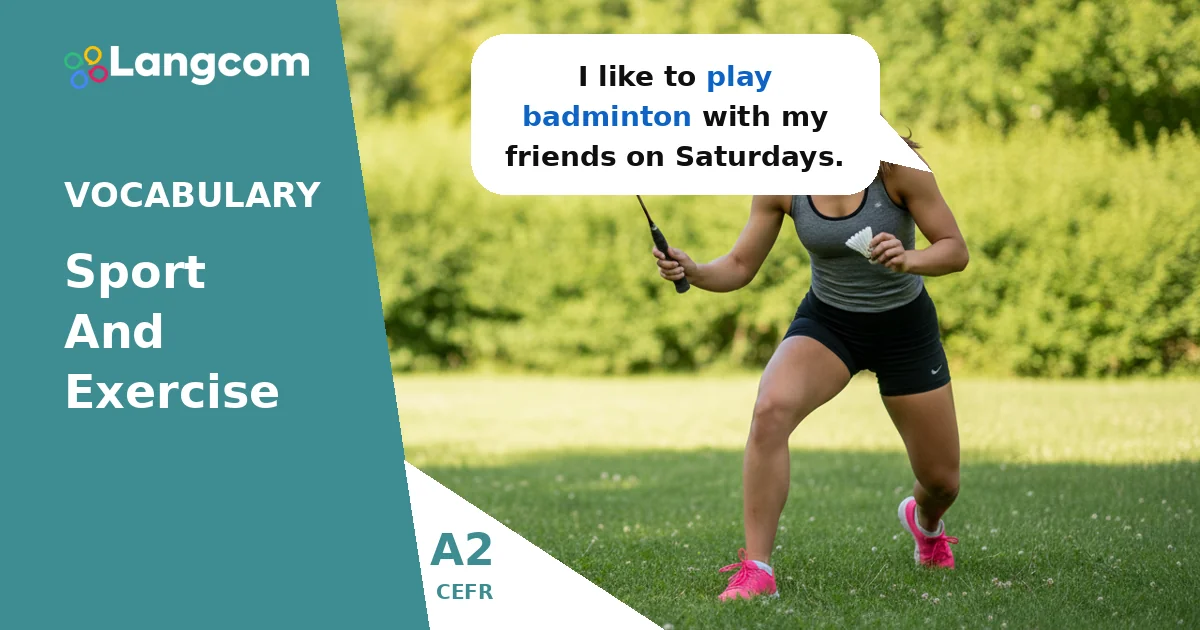
- I like to play badminton with my friends on Saturdays.
- She does yoga every morning to relax.
- We often go skiing in the mountains in winter.
- He loves to ride his bike in the park.
- They go skating at the ice rink every week.
- My sister wants to learn to dance.
- Do you want to play football this afternoon?
Übung
[langcom_cta variant=”whatsapp”]
Häufige Fehler bei Spanischsprechern
Using ‘Do’ for all activities
A common mistake for Spanish speakers is to use do for many sports, similar to ‘hacer’ in Spanish. However, English uses specific verbs.
- Falsch: I do football.
- Richtig: I play football.
- Falsch: She does swimming.
- Richtig: She goes swimming.
Remember to use play for ball/team sports, do for individual exercise, and go für -ing activities.
Häufig gestellte Fragen
Can I say ‘do sport’?
Yes, you can say do sport as a general phrase, meaning to participate in sports. However, when talking about a specific sport, it’s better to use play, do, oder go. For example, I do sport every weekend is correct, but I play football is more specific than I do football.
What about ‘run’ or ‘swim’?
Run und swim are verbs themselves. You can say I run every day oder I swim in the sea. However, go running und go swimming are also very common collocations, meaning to go somewhere specifically to do that activity. For example, Let’s go swimming!
Is it ‘do a bike’ or ‘ride a bike’?
The correct phrase is ride a bike. We use the verb ride for things you sit on and control, like a bicycle or a horse. We do not use do for this activity.




0 Kommentare