
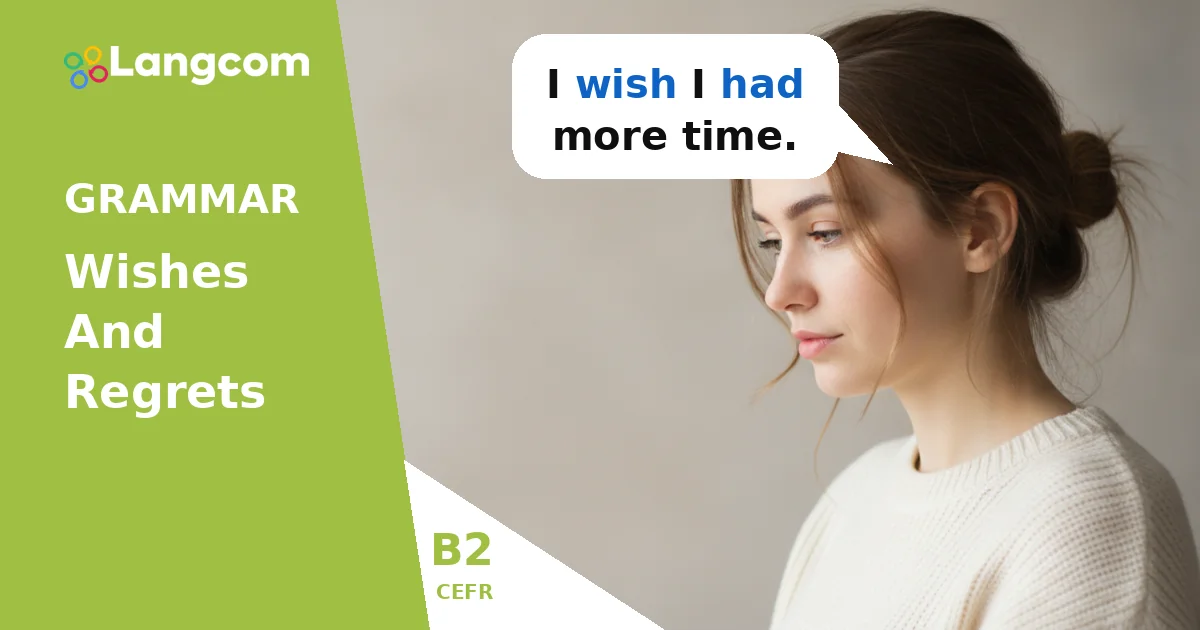

What Are Wishes and Regrets in English?
When we talk about wishes, we are imagining a situation that is different from reality. This can be about the present, the past, or the future.
Regrets are feelings of sadness or disappointment about something that happened or didn’t happen in the past. We often wish things had been different.
✍️ لست متأكدًا من مستواك؟
خُذ اختبار تحديد المستوى المجاني الخاص بنا واحصل على تعليقات مخصصة من ممتحنين معتمدين من كامبريدج.
قم بإجراء اختبار تحديد المستوى المجانيHow Do We Express Wishes About the Present?
To express a wish about a present situation that you want to be different, we use wish + past simple.
-
الاستخدام wish + past simple for situations that are not true now, but you want them to be true.
-
You can also use wish + could + infinitive to express a wish about an ability you don’t have now.
-
بالنسبة لـ I, he, she, it, we often use were بدلاً من was in formal English, but both are common in spoken English.
How Do We Express Wishes About the Future?
To express a wish about a future event or situation that you want to be different, we use specific structures.
-
الاستخدام wish + would + base verb when you want someone else to do something, or for a situation to change. This often implies annoyance or impatience.
-
Do NOT use would to make a wish about yourself. Instead, use wish + could + base verb to talk about your own future ability or possibility.
How Do We Express Regrets About the Past?
When we regret something that happened or didn’t happen in the past, we use the past perfect tense after wish.
-
الاستخدام wish + past perfect to express regret about a past action or situation that cannot be changed.
-
This structure means you are sorry about something that happened, or that you did not do something you wanted to do.
When Do We Use “If Only…”?
If only… has the same meaning as I wish… but it is often stronger and more emphatic. It expresses a deeper regret or a more intense desire for a situation to be different.
-
You use the same verb forms after if only as you do after wish (past simple for present, past perfect for past).
What About “Should Have + Past Participle”?
نحن نستخدم should have + past participle to express regret about our own past actions. It means we believe we made a mistake or did not do the right thing.
-
This structure shows that you now realize a different action would have been better.
-
It is specifically for reflecting on your own choices and actions.
Wish vs. Hope: What’s the Difference?
It is important to distinguish between wish و hope. They are not interchangeable.
-
نحن نستخدم hope when we talk about something that is realistic, possible, or likely to happen in the future.
-
نحن نستخدم wish when we talk about something that is unreal, impossible, or very unlikely to happen.
| Type of Wish/Regret | Structure | Example |
|---|---|---|
| Present Wish (unreal) | wish + past simple | I wish I had more time. |
| Present Wish (ability) | wish + could + infinitive | I wish I could speak Russian. |
| Future Wish (others/situations) | wish + would + base verb | I wish it would stop raining. |
| Future Wish (own ability) | wish + could + infinitive | I wish I could get a better job. |
| Past Regret | wish + past perfect | I wish I hadn’t been so lazy. |
| Past Regret (own action) | should have + past participle | I should have locked the door. |
أمثلة
- I wish I had more time.
- I wish I could speak Russian.
- If only it were that simple.
- I wish it would stop raining.
- I wish I could get a better job.
- I wish I hadn’t been so lazy at school.
- If only I had studied harder for the exam.
- It’s my fault. I should have locked the door.
- I hope you get better soon.
- I hope nothing has happened to them.
التدريب
هل أنت مستعد للحصول على شهادتك؟
يُعد برنامج Langcom الطلاب لامتحانات كامبريدج وIELTS وTOEFL وDELE وSIELE وMichigan.
ابدأ مع Langcomالأخطاء الشائعة لدى المتحدثين باللغة الإسبانية
Spanish speakers often make these common mistakes:
- Using present tense after wish for present wishes:
خطأ: I wish I am rich.
الصحيح: I wish I were rich. (أو I wish I was rich.) - مربك wish و hope:
Incorrect (for a realistic future event): I wish you would get better soon.
الصحيح: I hope you get better soon. - استخدام would for one’s own future wishes:
خطأ: I wish I would fly.
الصحيح: I wish I could fly. - Direct translation of ‘Ojalá’: While ‘Ojalá’ can express strong wishes or hopes, its English equivalents require specific grammatical structures (e.g., If only I knew! أو I wish I knew!). Do not translate directly word-for-word.
الأسئلة الشائعة
What is the main difference between ‘wish’ and ‘hope’?
نحن نستخدم hope for things we want to happen that are possible or likely, like I hope it doesn’t rain tomorrow. نحن نستخدم wish for things that are impossible, unreal, or very unlikely, or for expressing regret, like I wish I could fly.
Can I use ‘was’ instead of ‘were’ after ‘wish’ for I/he/she/it?
نعم، يمكنك استخدام was بدلاً من were بعد wish for I, he, she, ، و it in informal spoken English. For example, I wish I was taller is common, though I wish I were taller is preferred in more formal contexts.
When do we use ‘should have + past participle’?
نحن نستخدم should have + past participle to express regret about a past action that you did or didn’t do. It means you now think it was a mistake, for example, I should have called her.
Is ‘if only’ more formal than ‘I wish’?
لا،, if only is not necessarily more formal than I wish. It is usually used to express a stronger, more intense feeling of wish or regret. It adds emphasis to the statement.




0 تعليق